 English
 Español
  Português
  русский
  Français
  日本語
日本語  Deutsch
  tiếng Việt
  Italiano
  Nederlands
  ภาษาไทย
  Polski
  한국어
한국어  Svenska
  magyar
  Malay
Malay  বাংলা ভাষার
  Dansk
Dansk  Suomi
Suomi  हिन्दी
  Pilipino
  Türkçe
  Gaeilge
  العربية
  Indonesia
  Norsk
Norsk  تمل
تمل  český
český  ελληνικά
  український
  Javanese
  فارسی
فارسی  தமிழ்
தமிழ்  తెలుగు
  नेपाली
  Burmese
  български
  ລາວ
ລາວ  Latine
  Қазақша
  Euskal
  Azərbaycan
  Slovenský jazyk
  Македонски
  Lietuvos
  Eesti Keel
  Română
  Slovenski
  मराठी
मराठी  Srpski језик


How Does a Cement Tank Trailer Improve Bulk Cement Transportation Efficiency?
Article Summary: Cement tank trailers are engineered to transport bulk powdered materials such as cement, fly ash, and lime efficiently and safely. This article explores how these specialized trailers work, their structural advantages, key technical parameters, and how they address common logistics challenges such as material loss, unloading inefficiency, and high operational costs. Practical selection tips are also provided to guide procurement decisions.
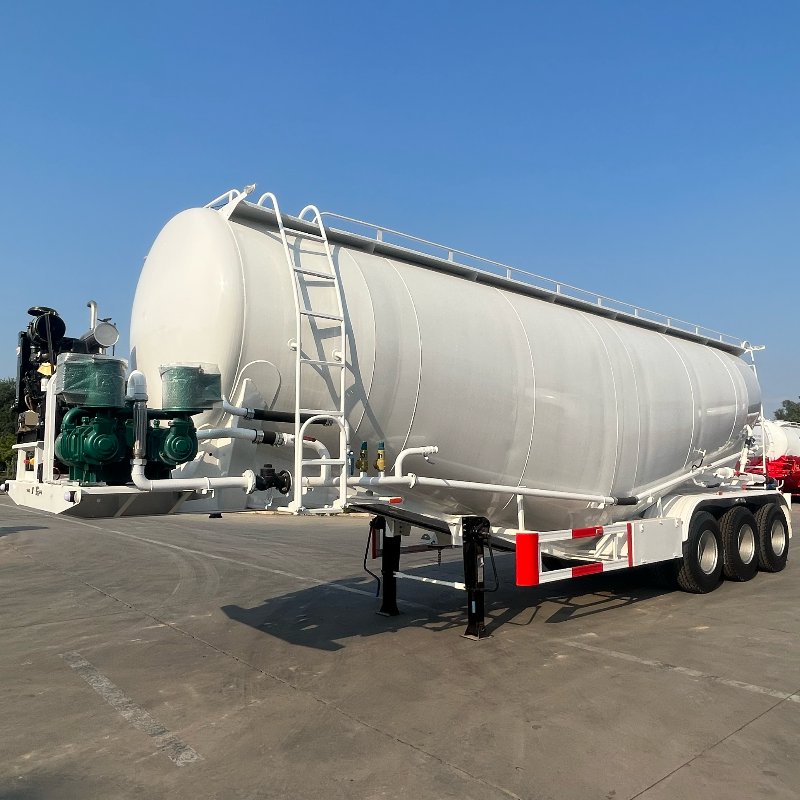
Table of Contents
- 1. Overview of Cement Tank Trailers
- 2. How Cement Tank Trailers Work
- 3. Key Structural Components
- 4. Major Advantages for Transportation
- 5. Technical Parameters
- 6. How to Choose the Right Trailer
- 7. Common Applications
- 8. Frequently Asked Questions
1. Overview of Cement Tank Trailers
A cement tank trailer, also known as a bulk cement tanker, is a specialized vehicle designed to transport dry powder materials in bulk form. Unlike bagged cement transportation, this solution eliminates packaging costs and reduces material waste.
Manufacturers such as Shandong Derun Vehicle have developed advanced tanker designs that integrate aerodynamic structures, efficient pneumatic unloading systems, and high-strength materials to optimize transport efficiency.
These trailers are widely used in construction, infrastructure development, and industrial material supply chains.
2. How Cement Tank Trailers Work
The operational principle of a cement tank trailer is based on pneumatic conveying technology.
- Loading Process: Cement is loaded into the sealed tank through top inlets using gravity or external pumping systems.
- Transportation: The airtight tank prevents moisture contamination and material leakage during transit.
- Unloading Process: Compressed air is injected into the tank, fluidizing the cement and pushing it through discharge pipes.
This system allows for fast, residue-free unloading without requiring additional mechanical handling equipment.
3. Key Structural Components
The performance of a cement tank trailer depends on its structural design. Below are the main components:
- Tank Body: Typically V-shaped or W-shaped for optimal material flow
- Air Compressor: Provides the pressure required for unloading
- Fluidized Bed System: Ensures even distribution of compressed air
- Discharge Pipeline: Transfers cement to storage silos
- Manholes: Allow inspection and maintenance
- Chassis: Supports structural integrity and load distribution
The internal design minimizes dead zones, ensuring complete unloading and reducing material residue.
4. Major Advantages for Transportation
Cement tank trailers address several critical challenges in bulk material logistics:
- Reduced Material Loss: Fully sealed system prevents leakage and contamination
- Lower Transportation Costs: Eliminates packaging and handling expenses
- Faster Unloading: Pneumatic systems significantly reduce unloading time
- Improved Safety: Reduces manual handling and dust exposure
- High Efficiency: Enables continuous bulk delivery to construction sites
These advantages make cement tank trailers an essential asset in modern logistics operations.
5. Technical Parameters
| Parameter | Specification Range |
|---|---|
| Tank Volume | 30 – 80 cubic meters |
| Material | Carbon steel / Aluminum alloy |
| Discharge Speed | 1.2 – 1.5 tons/min |
| Residual Rate | < 0.3% |
| Working Pressure | 0.2 MPa |
| Axles | 2 – 4 axles |
These parameters may vary depending on customization requirements and operational conditions.
6. How to Choose the Right Trailer
Selecting the appropriate cement tank trailer requires evaluating multiple factors:
1. Material Type
- Cement
- Fly ash
- Lime powder
2. Capacity Requirements
- Small-scale projects: 30–40 m³
- Large-scale operations: 50–80 m³
3. Tank Material
- Carbon steel: Cost-effective
- Aluminum alloy: Lightweight and fuel-efficient
4. Unloading System Efficiency
- Check compressor performance
- Evaluate discharge speed
5. Manufacturer Reliability
Working with experienced manufacturers such as Shandong Derun Vehicle ensures consistent quality, after-sales support, and customization options.
7. Common Applications
Cement tank trailers are widely used across multiple industries:
- Construction and infrastructure projects
- Cement manufacturing plants
- Concrete batching facilities
- Road and bridge construction
- Industrial material transport
They play a critical role in ensuring uninterrupted supply chains for bulk materials.
8. Frequently Asked Questions
Q1: What materials can a cement tank trailer transport?
A: In addition to cement, these trailers can transport fly ash, lime powder, silica powder, and other dry bulk materials.
Q2: How long does it take to unload a full trailer?
A: Typically, unloading takes 30–60 minutes depending on capacity and compressor efficiency.
Q3: What is the maintenance requirement?
A: Regular inspection of the air compressor, valves, and sealing system is necessary to ensure optimal performance and longevity.
Q4: Is aluminum alloy better than carbon steel?
A: Aluminum alloy reduces weight and improves fuel efficiency, while carbon steel offers higher durability at a lower cost.
Q5: How can material residue be minimized?
A: Choosing a well-designed fluidized bed system and proper tank angle ensures near-complete discharge.
Conclusion
Cement tank trailers represent a highly efficient solution for bulk powder transportation. Their sealed design, pneumatic unloading system, and optimized structure significantly reduce operational costs while improving delivery efficiency.
For businesses aiming to enhance logistics performance and minimize material waste, investing in a high-quality trailer from Shandong Derun Vehicle is a strategic decision.
Contact us today to get customized solutions, competitive pricing, and professional support tailored to your bulk transportation needs.
Previous:Happy Year of the Horse!
Send Inquiry



X
We use cookies to offer you a better browsing experience, analyze site traffic and personalize content. By using this site, you agree to our use of cookies.
Privacy Policy